Greenhouse Plastic Film
3422
April 3, 2025, 10:00 AM
home.Guide
home.Highlights at a glance
Artikel ini secara komprehensif membahas sifat dasar, klasifikasi, proses manufaktur, aplikasi, serta rantai pasok film rumah kaca. Dijelaskan komposisi polimer utama (PE, EVA, PVC), berbagai aditif fungsional (UV stabilizer, IR absorber, anti-fog), struktur multi-layer, serta sifat fisik, termal, kimia, dan ketahanan penuaan. Artikel juga mengulas klasifikasi berdasarkan fungsi (thermal, diffused, UV-blocking), struktur polimer, dan masa pakai, serta proses produksi seperti blown/cast extrusion dan post-treatment. Selain itu, dibahas adaptasi regional, aplikasi spesifik tanaman, dan dinamika industri hulu-hilir—mulai dari pasokan resin hingga preferensi pengguna akhir.

1.Basic Properties and Characterisitics
1.1 Material Composition
1.1a Primary Polymer Types
-
Polyethylene(PE): 70%-80% of greenhouse film market
-
Low-density polyethylene (LDPE): most common, 0.910-0.925g/cm³
-
Linear low-density polyethylene (LLDPE): 0.915-0.935g/cm³
-
High-density polyethylene (HDPE): 0.941-0.965 g/cm³
-
-
Ethylene-vinyl acetate copolymer (EVA): 5-20% vinyl acetate content
-
Polyvinyl chloride (PVC): decreasing market share due to environmental concerns
-
Ethylene-butyl acrylate copolymer(EBA): Specialized applications
-
Polycarbonate (PC): high-end greenhouse coverings
1.1b Additives and Modifiers
-
UV stabilizers: Hindered Amine Light Stabilizers(HALS), benzophenones, benzotriazoles, 0.5-2.0% concentration.
-
Infrared (IR) additives: Metal oxides, silicates, 1-5% concentration
-
Light diffusion agents: CaCO₃, talc, TiO₂, 2-10% concentration
-
Anti-fog/Anti-drip agents: Glycerol esters, ethoxylated alcohols, 0.5-2.0% concentration
-
Anti-dust additives: Silicone-based compounds, 0.1-0.5% concentration
-
Flame retardants: Brominated compounds, phosphorus-based additives
1.1c Multi-layer Film Structure
-
Monolayer: Single polymer with additives, 80-150μm thickness
-
3-layer films: Typical structure- outer layer (UV protection), middle layer (strength), inner layer(IR, anti-fog)
-
5-layer films: Enhanced performance, specialized barrier properties
-
7-9 layer films: Advanced barrier properties, specialized applications
-
Layer thickness ratio: Typically 15/70/15 for 3-layer films
1.2 Physical Properties
-
Thickness Range
-
Seasonal films: 30-100μm
-
Multi-season films: 100-200μm
-
Long-life films: 180-250 μm
-
Regional Variations: Thinner in warm climates(60-120μm), thicker in cold regions(150-220μm)
-
Thickness tolerance: ±5% within roll, ±10% between manufacturing batches
-
-
Optical Properties
Property Standard Film Diffused Film Thermal Film PAR Transmission (400-700 nm) 85-92% 80-88% 82-89% UV Transmission (280-400 nm) 15-80% 10-70% 5-60% IR Transmission (7-14 μm) 60-80% 60-80% 20-40% Haze 10-30% 50-80% 20-40% Light Diffusion 20-30% 60-85% 30-50% -
Mechanical Properties
Property LDPE LLDPE EVA (12% VA) Tensile Strength (MD/TD, MPa) 20-28/16-24 35-45/25-35 25-32/20-28 Elongation at Break (MD/TD, %) 300-500/400-600 600-800/700-900 500-700/600-800 Tear Resistance (MD/TD, g/μm) 2-4/8-12 8-12/15-25 5-10/12-20 Dart Impact Strength (g/μm) 2-4 6月10日 8月15日 Puncture Resistance (N/mm) 10-20 25-40 30-45
Note: MD = Machine Direction TD= Transverse Direction
-
Thermal Properties
-
Operating temperature range: -40°C to +60°C (standard films)
-
Heat retention coefficient: 15-20% (standard film), 55-65% (thermal film)
-
Thermal resistance (R-value): 0.83-0.87m²·K/W (single layer), 1.4-1.7 m²·K/W (double layer with air gap)
-
Temperature difference (inside vs. outside): 1-3°C (standard film), 3-8°C (thermal film) during night
-
Heat capacity: 1.9-2.3 kJ/kg·K (PE films)
-
-
Aging and Durability
-
Service life: 1 season (6-9 months) for standard film, 2-3 years for multi-season 4-5+ years for long-life films
-
UV degradation rate: 5-10% loss in tensile strength per month of exposure without stabilizers
-
Retention of light transmission: 90-95% after 1 year, 80-85% after 3 years, 70-75% after 5 years
-
Weatherability (desert conditions): Service life reduced by 30-50%
-
Cold region performance: Becomes brittle below -30°C for standard PE, -40°C for premium films
-
1.3 Chemical Properties
-
Chemical Resistance
Chemical Agent LDPE EVA PVC Acids (weak) Excellent Excellent Good Acids (strong) Good Good Poor Alkalis Excellent Excellent Good Alcohols Good Fair Good Pesticides Good-Excellent Good Good Chlorinated compounds Poor Poor Poor Petroleum products Poor Poor Poor -
Surface Properties
-
Surface energy: 30-32mN/m (LDPE), 33-36 mN/m (EVA)
-
Water contact angle:90-100° (untreated), 50-70° (with anti-fog additives)
-
Surface resistivity:10¹²-10¹⁵ Ω/square
-
Coefficient of friction: 0.2-0.3 (untreated), 0.1-0.15 (slip additives)
-
Dust adhesion index: 6-8 (standard film), 2-4 (anti-dust films), scale 1-10
-
2.Types and Classification
2.1 Classification by Functional Properties
-
Standard (clear) Films:
-
Composition: Primarily LDPE/LLDPE
-
Light transmission: > 85% PAR
-
Haze value:
-
Applications: Basic crop protection, short growing seasons
-
Market share: 35-40% of greenhouse film market
-
Thermal/IR Films
-
Composition: PE/EVA with mineral IR additives or PE/EVOH layers
-
Wavelength blocking: 7-14μm (far infrared)
-
Heat retention improvement: +30-50% compared to standard film
-
Night temperature benefit:+2-5°C versus standard film
-
Cost premium: 20-35% over standard film
-
-
Diffused Light Films
-
Composition: PE/EVA with light diffusion additives(typically CaCO₃, talc)
-
Haze value: 50-80%
-
Direct/Diffuse light ratio: 30/70 to 15/85
-
Yield improvement: 5-15% for shade-intolerant crops
-
Light penetration into canopy: 30-50% deeper than standard films
-
-
UV-Blocking Films
-
UV transmission:
-
Pest reduction: 30-60% decrease in certain insect populations
-
Fungal disease reduction: 20-45% less powdery mildew incidence
-
Limitations: May reduce pollinator activity, certain crops require UV
-
-
Anti-Drip/Anti-Fog Films
-
Surface tension: >50 mN/m (treated surface)
-
Water contact angle:
-
Light transmission benefit: +5-10% compared to drip-covered standard film
-
Condensation pattern: Film formation rather than droplets
-
Duration of effectiveness: 1-3 years
-
Colored and Spectral-Selective Films
-
Types: Red, blue, pearl, silver, fluorescent
-
Red Films: R:FR ratio 1.1-1.4 (standard film 1.0-1.1)
-
Blue Films:Enhanced B:R ratio, typically 0.45-0.55 (standard 0.25-0.35)
-
Pearl/white films: Reflection 30-45% (vs.10-12% for clear)
-
Applications: Plant height conrol, flowering manipulation, insect management
-
Yield effects: Highly crop-specific, -10% to +15% depending on crop/color
-
2.2 Classification by Polymer Structure
-
Single Polymer Films
-
Primarily LDPE (70-80% of market)
-
Thickness: 30-200μm
-
Manufacturing: primarily blown film extrusion
-
Cost: lowest among greenhouse films
-
Service life: 6-12 months without additives
-
-
Copolymer Films
-
EVA (vinyl acetate 5-18%)
-
EBA (butyl acrylate 5-15%)
-
Thermal properties: improved over homopolymers
-
Clarity: superior to pure PE films
-
Flexibility at low temperatures: remains flexible to -30°C with 12% VA content
-
-
Multi-layer films
-
Layer bonding: coextrusion with tie layers when needed
-
Performance: each layer optimized for a specific function
-
Market trend: growing at 12-15% annually, faster than single-layer
-
Cost premium: 25-50% over monolayer films
-
2.3 Classification by Duration/lifespan
-
Seasonal Films(6-12months)
-
Composition: primarily LDPE with basic UV stabilizers
-
Thickness: 30-100μm
-
UV stabilizer package: 0.5-1.0%
-
Applications: Annual crops, low-cost operations
-
Regional usage: dominant in developing countries, southern regions
-
-
Multi-Season Films (2-3 years)
-
Composition: LDPE/LLDPE blends, often with EVA
-
Thickness: 120-180μm
-
HALS concentration: 0.8-1.5%
-
Light transmission after 24 months: minimum 80% of initial
-
-
Long-life films(4-5+ years)
-
Composition: premium PE blends with EVA/EBA, multi-layer
-
Thickness: 180-250μm
-
UV stabilizer systems: complex packages with synergistic effects
-
Metal deactivators: 0.1-0.3% to prevent catalyst-induced degradation
-
Warranty periods: Typically 4-5 years in temperate climates
-
3.Manufacturing Process
3.1 Basic Production Methods
-
Blown Film Extrusion
-
Market share: 85-90% of greenhouse films
-
Extrusion temperature: 160-220°C
-
Die Gap: 0.8-2.5 mm
-
Blow-up ratio (BUR): 1.5-3.0
-
Line speed: 20-150 m/min depending on thickness
-
Air ring cooling systems: Dual-lip or triple-lip designs
-
-
Cast Film Extrusion
-
Market share: 10-15% of greenhouse films
-
Applications: mainly specialized high-clarity films
-
Extrusion temperature: 180-240°C
-
Chill roll temperature: 20-40°C
-
Advantages: Superior optical clarity, thickness consistency
-
Limitations: generally lower impact strength than blown films
-
-
Multi-layer Coextrusion
-
Layer thickness ratio control: ±5% accuracy
-
Interfacial surface quality: critical for optical properties
-
Processing challenges: matching rheological properties between layers
-
Layer adhesion strength:typically 3-5N/15mm for compatible polymers
-
3.2 Post-Production processing
-
Corona Treatment
-
Surface energy increase: from 31-32mN/m to 42-56 mN/m
-
Treatment levels: 38-45 dyne/cm for printing applications
-
Aging of treatment: 30-50% loss of effectiveness within first month
-
Applications: improving anti-fog performance, printability
-
Power requirements: 2-5W/m²/min
-
-
Surface Coating Application
-
Coating types: anti-fog, anti-dust, anti-viral
-
Application methods: offline roller coating, spray systems
-
Coating thickness: 1-5μm
-
Adhesion requirements: 4B rating (ASTM D3359)
-
Durability: 1-3 growing seasons
-
-
UV Curing Processes
-
Applications: specialized hardcoatings, anti-abrasion treatments
-
UV dose: 100-300mJ/cm²
-
Cure speed: 5-30 m/min
-
Coating Thickness: 3-15μm
-
Marketing segment: Premium greenhouse films, 2-5% market share
-
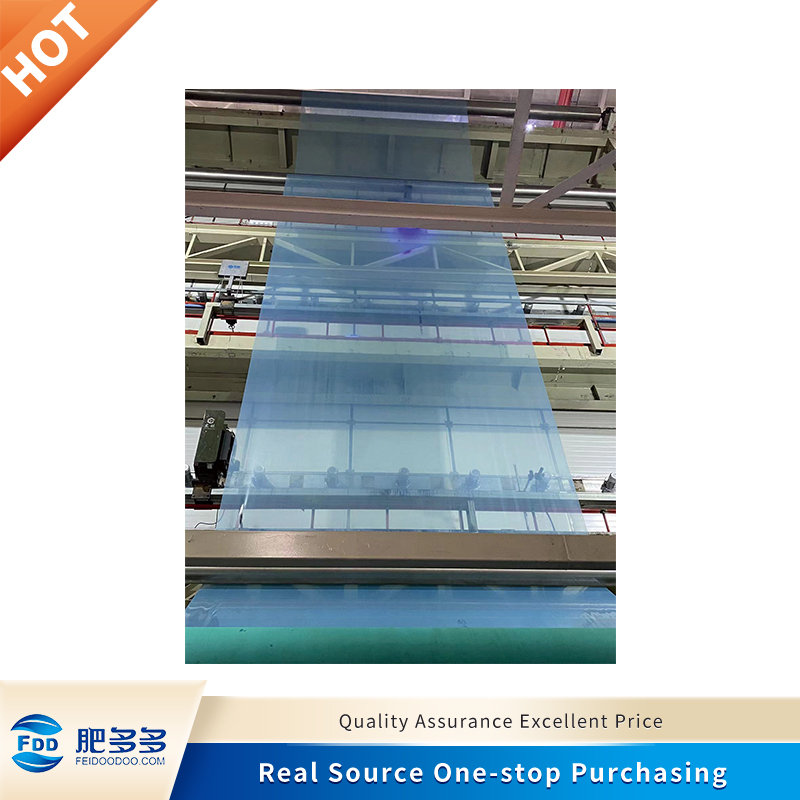
FDD 100 / 120 / 150 / 180 / 200 / 250 Mikron Anti-Drip 5 Lapisan UV Tahan Jelas Rumah Kaca Film Plastik
$ 0.4
/Square Meter
MOQ: 1Square Meter
Product Model: FDD-greenhouse UV plastic film
Profil Pemasok
Ningbo Feidoodoo E-Commerce Co., Ltd
Didirikan: 2019-10-10
Ukuran Perusahaan: 500
Dapatkan Harga Terbaik
4.Applications and Usage Methods
4.1 Greenhouse Structures and Installation
4.1a Greenhouse structure compatibility
-
Single-span tunnels: films 120-180μm, 4-12m width
-
Multi-span greenhouses: films 150-200μm, typically 8-16m width
-
Film lifespan correlation with structure: Metal structures with sharp edges reduce life by 15-30%
-
Attachment systems: wiggle wire/channel (40-50%), batten tape (20-30%), lock profiles(15-20%)
-
Installation tension: 3-5% elongation recommended (varies by structure)
4.1b Multi-layer installations
-
Double-layer inflated systems: 0.3-0.5 kPa air pressure
-
Air gap optimization: 8-10 cm ideal spacing
-
Energy savings: 35-45% versus single layer
-
Condensation management: Critical between layers
-
Blower systems: 25-60W fans, 0.1-0.3 air changes per hour
4.1c Regional Adaptation Strategies
| Climate Zone | Recommended Film Type | Thickness | Special Feature |
| Mediterranean | EVA 12-16% | 180-200 μm | IR, Anti-drip |
| Northern Europe | EVA 14-18% | 200-220 μm | High IR retention, Anti-condensation |
| Desert/Arid | PE/EVA with additives | 150-200 μm | UV resistance, NIR reflection |
| Tropical | PE with UV stabilizers | 150-180 μm | UV blocking, Anti-fungal |
| High Altitude | EVA >12% | 180-220 μm | UV resistance, IR retention |
4.2 Crop-specific applications
-
Vegetable Production
-
Tomato: diffused light films increase yield 7-12%, improve quality
-
Cucumber: anti-drip films critical, 8-15% yield increase
-
Pepper: thermal films extend season by 2-4 weeks
-
Leafy greens: UV- Blocking films reduce tipburn by 30-60%
-
Strawberry: Red-tinted films increase sugar content by 5-12%
-
-
Ornamental Production
-
Flowering Regulation: blue-tinted films increase flowering in short-day plants
-
Plant height control: Far-red filtering films reduce stem elongation 15-25%
-
Rooting improvement: pearl films increase root mass 10-20% in cuttings
-
Quality factors: UV-transmitting films improve color development in read varieties
-
Season extension: thermal films allow 3-5 weeks earlier production in spring
-
-
Speciality Applications
-
Medicinal cannabis:Diffused films with UV-A transmission optimize cannabinoid profiles
-
Microgreen production: blue-enhanced films increase anthocyanin content 25-40%
-
Tissue culture hardening: Gradient UV-permeable films for acclimatization
-
Nursery propagation: Anti-corrosion films with specialized additives
-
5.Upstream and Downstream Industry Relationships
5.1 Upstream Raw Material Supply Chain
5.1a Polymer Resin Production
-
LDPE global production: ~25 million tons/year, 5-8% used in agricultural films
-
LLDPE for films: C4, C6, and C8 co-monomer types
-
Resin pricing factors: Ethylene price (60-70% of cost), energy costs (10-15%)
-
Price volatility: PE film-grade resin varies 15-30% annually
-
Major producers: ExxonMobil, SABIC, Dow, LyondellBasell, INEOS, Sinopec
-
Regional capacity: Asia-Pacific (45%), North America (25%), Europe (20%), others (10%)
5.1b Raw Material Quality Impact
-
Resin Melt flow rate(MFR) variation: ±10% typical between batches
-
Molecular weight distribution effects: Narrower MWD improves optical properties, reduces mechanical strength
-
Catalyst residue effects: Titanium residues accelerate UV degradation
-
Additive compatibility issues: Interaction between HALS and Sulfur-containing pesticides
-
Quality control parameters: Gel count
5.1c Supply Chain Challenges
-
Polymer Supply volatility: 15-25% price fluctuations annually
-
Additive lead times: specialized additives 4-12 weeks
-
Force majeure incidents: Average 3-5 major supply disruptions annually in PE industry
-
Raw material traceability: increasingly required for food-contact applications
5.2 Manufacturing Ecosystem
5.2a Film Extrusion Industry Structure
-
Global Capacity: 1.2-1.5 million tons/years for greenhouse films
-
Industry concentration: Top 10 manufacturers represent 40-45% of the market
-
Regional Production Capacity:
Region Share Annual Growth Specialization Asia 52% 7-9% Standard films, multi-layer Europe 22% 2-3% High-performance, specialty films North America 14% 3-5% Multi-layer, long-life films Middle East 8% 6-8% Standard films, UV-resistant Others 4% 4-6% Varies by market
5.2b Technology Development Relationships
-
Resin supplier-film manufacturer cooperation: 75% of new formulations
-
Additive supplier innovation role: Critical for 80% of performance improvements
-
Equipment manufacturer contribution: Enabling multi-layer technologies
-
University/research institute partnerships: Present in 30-40% of major innovations
5.3 Downstream Distribution and End Users
5.3a Distribution Channels
-
Direct sales to large growers: 15-20% of volume
-
Agricultural distributors/dealers: 45-55%
-
Greenhouse manufacturers: 15-20%
-
Retail/garden centers: 5-10%
-
Online sales: Growing at 20-25% annually, currently 5-8% of the market
-
Regional distribution models:
Region Primary Channel Secondary Channel Trend Europe Specialized distributors (60%) Direct sales (25%) Increasing consolidation North America Ag dealers (50%) Greenhouse builders (30%) Growing online sales Asia Local distributors (70%) Direct import (15%) Emerging organized retail LATAM Agricultural dealers (65%) Direct import (20%) Increasing technical support
5.3b End User Segmentation
-
By operation size:
-
Large commercial (>10 hectares): 25-30% of market volume
-
Medium commercial (1-10 hectares): 40-45%
-
Small Commercial (
-
Research/institutional: 5-10%
-
By crop type:
-
Vegetables: 55-60%
-
Ornamentals: 15-20%
-
Fruits & berries : 10-15%
-
Nursery/propagation: 5-10%
-
5.3c User requirements and Trends
-
Film Selection drivers(ranked):
-
Durability/lifespan
-
Cost-performance ratio
-
Optical properties
-
Thermal properties
-
Special functionalities
-
-
Service requirements
-
Technical support: Critical for 60-70% of medium/large users
-
Warranty terms: 85-90% of users consider essential
-
Local availability: 50-60% won't switch if requires import
-
Custom dimensions: required by 30-40% of users
-
-
Technology adoption patterns
-
Early adopters: 10-15% of users
-
Majority adopters: 45-55%
-
Late adopters: 30-40%
-
-
Lebih banyak Berita Sourcing
76595
July 4, 2025
72825
July 10, 2025
70857
July 10, 2025
63732
July 4, 2025
60911
July 10, 2025